If you’re building a blockchain project, one of the first and most important decisions you’ll face is:
👉 Which token standard should you use?
Choosing the wrong one can:
- Limit your project’s functionality
- Increase development complexity
- Affect scalability and user experience
Choosing the right one can:
- Improve performance
- Enhance user engagement
- Unlock powerful features
In this guide, we’ll break down how to choose the best token standards for your project with real use cases and practical insights.
What Are Token Standards?
Token standards are predefined rules and protocols that define how tokens behave on a blockchain.
They determine:
- How tokens are created
- How they are transferred
- How they interact with smart contracts
Think of token standards as blueprints for your crypto assets.
Why Token Standards Matter
Choosing the right standard impacts:
- Functionality (fungible vs non-fungible)
- Compatibility with wallets & exchanges
- Development complexity
- Scalability
This is a critical step in blockchain token development.
Most Popular Token Standards Explained
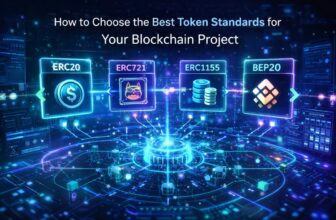
ERC20 Token Standard (Fungible Tokens)
What it is:
The most widely used token standard on Ethereum.
Best for:
- Cryptocurrencies
- Utility tokens
- Stablecoins
Features:
- Interchangeable tokens
- High compatibility
- Easy integration
Ideal for ERC20 token development
ERC721 Token Standard (NFTs)
What it is:
A standard for non-fungible tokens (NFTs).
Best for:
- Digital art
- Collectibles
- Gaming assets
Features:
- Unique tokens
- Ownership tracking
- Metadata support
Commonly used for NFT platforms
ERC1155 Token Standard (Hybrid)
What it is:
A multi-token standard supporting both fungible and non-fungible tokens.
Best for:
- Gaming ecosystems
- Metaverse projects
Features:
- Batch transfers
- Lower gas fees
- Multiple token types
A powerful alternative to ERC20 + ERC721
BEP20 Token Standard (BNB Chain)
What it is:
A token standard on BNB Chain similar to ERC20.
Best for:
- Low-cost transactions
- Fast execution
Features:
- Lower gas fees
- High speed
- Growing ecosystem
Popular for crypto token development projects.
| Feature | ERC20 | ERC721 | ERC1155 | BEP20 |
|---|---|---|---|---|
| Token Type | Fungible | Non-Fungible | Hybrid | Fungible |
| Use Case | Crypto, DeFi | NFTs | Gaming, Metaverse | Crypto |
| Gas Fees | Medium | High | Lower | Low |
| Flexibility | Low | Medium | High | Medium |
How to Choose the Right Token Standard
Let’s simplify decision-making 👇
Choose ERC20 if:
- You need a cryptocurrency or utility token
- You want wide compatibility
Choose ERC721 if:
- Your project involves NFTs
- Each asset is unique
Choose ERC1155 if:
- You need both fungible and non-fungible tokens
- You want lower gas fees
Choose BEP20 if:
- You want low transaction costs
- You’re targeting BNB Chain users
Key Factors to Consider
1. Project Type
- DeFi → ERC20
- NFT → ERC721
- Gaming → ERC1155
- Transaction Costs
- Ethereum = higher fees
- BNB Chain = lower fees
3. Ecosystem Compatibility
Choose a standard supported by:
- Wallets
- Exchanges
- Platforms
4. Security & Smart Contracts
Ensure strong smart contract development and audits.
Future Trends in Token Standards (2026)
- Cross-chain token standards
- AI-integrated tokens
- Real World Asset (RWA) tokens
- Interoperability-focused protocols
Token standards are evolving rapidly in Web3 development.
Common Mistakes to Avoid
- ❌ Choosing based on hype
- ❌ Ignoring scalability
- ❌ Not considering gas fees
- ❌ Skipping security audits
Why Choose Professional Token Development Services
Selecting Professional Token Development Services and implementing the right token standard requires expertise.
A professional team offers:
- Token creation services
- Smart contract development
- Blockchain integration
- Security audits
This ensures your project is scalable, secure, and future-ready.
Conclusion
Choosing the right token standard is more than just a technical checkbox it’s a foundational decision that shapes your entire blockchain project.
From how your token behaves to how users interact with it, everything is influenced by this choice.
- ERC20 gives you reliability and wide adoption for DeFi and utility tokens
- ERC721 unlocks true ownership for NFTs and digital assets
- ERC1155 offers flexibility and efficiency for complex ecosystems like gaming and metaverse
- BEP20 provides cost-effective and scalable solutions for fast-growing projects
But here’s the real insight most founders overlook:
👉 It’s not about picking the “best” token standard
👉 It’s about picking the right one for your specific use case, audience, and long-term vision.